

“Can I pick this up at a different store tomorrow?” Buy online, pick up in store (BOPIS) and local pickup orders on Shopify share checkout with ship-to-home—but after payment, change requests hit store inventory, pickup notifications, and fulfillment location rules that do not mirror a shipping-address edit.
This article is for omnichannel merchants and support leads. It compares what customers typically can change on pickup orders after checkout, how processing vs ready for pickup states matter, and why ship-to-home address macros do not apply.
Quick answer
| Change request | Pickup order (general guidance) | Ship-to-home contrast |
|---|---|---|
| Pickup store / location | Sometimes before prep starts; often blocked once assigned to a store’s queue | N/A—use shipping address workflows instead |
| Pickup date or time window | Often via support or store ops if slots exist; harder when marked ready | Use delivery date / carrier options, not store calendar |
| Contact email or phone | Usually yes pre-pickup; needed for “ready” SMS/email | Same contact fields, but carrier uses shipping address |
| Line items, variant, quantity | Pre-fulfillment edits if store stock supports; constrained after pick begins | Similar pre-ship edit window; inventory at FC not store |
| Shipping address | Does not apply—there is no ship-to address on pure pickup | Primary post-checkout edit category |
“Can change” always means your published policy plus inventory at the assigned location, not unlimited Shopify admin freedom.
Why BOPIS change tickets differ from ship-to-home
Pickup customers still say “change my order,” but they mean:
- Move pickup from Store A to Store B closer to work.
- Delay pickup a day because travel plans shifted.
- Swap size after trying on thinking they will pick up tomorrow.
- Fix a phone number so the “ready for pickup” text arrives.
Ship-to-home tickets center on address, carrier service, and delivery intercepts. Pickup tickets center on store ops, shelf hold time, and location-level stock.
Training should start with: Is this order pickup or delivery? Then: Has the store started preparing or marked it ready?
Common post-checkout change requests
Change pickup store
Feasible when: The order is unfulfilled at the original location, destination store has stock, and your POS or OMS allows location reassignment without a cancel-and-reorder.
Hard when: Item was already picked, transferred from backroom, or reserved at Store A. Moving may require cancel line + new order at Store B.
Document whether customers may self-serve store changes or must contact support.
Reschedule pickup day or time
Feasible when: You use appointment slots or hold windows and the order is not yet in ready for pickup.
Hard when: Perishable hold limits, same-day prep, or short pickup expiry policies (e.g., three days before return to shelf).
Publish how long you hold ready orders and whether extensions require store manager approval.
Update contact information
Email and phone corrections are among the most reasonable pre-pickup fixes—they affect notifications, not shelf inventory. Still verify identity on high-value orders.
Edit line items, variants, or quantities
Follows the same broad pre-fulfillment logic as ship-to-home: if the store has not committed pick and stock exists at that location, staff may adjust lines or swap variants. After partial pick or when the order shows ready for pickup, line changes often require canceling unpicked lines or issuing a new order.
Payment: Increasing quantity may need additional authorization or capture, same as ship orders.
“Change my address” on a pickup order
Pure BOPIS does not use a customer shipping address for fulfillment. Agents should not run shipping-address macros; redirect to store location, pickup person name (if you collect it), or billing only when relevant to payment disputes.
Mixed carts (ship some lines, pickup others) need line-level macros: ship lines follow address rules; pickup lines follow store rules.
Pickup-ready vs still processing
Store and Shopify statuses vary by setup, but ops teams usually distinguish:
| State (conceptual) | What customers expect | Change flexibility (typical) |
|---|---|---|
| Order received / processing | “We’re getting it ready” | Higher—store, slot, lines, contact often still movable |
| Preparing / in progress | “Staff is picking your items” | Medium—location changes harder; line swaps case-by-case |
| Ready for pickup | “Come to the counter” | Low—line and store changes often need cancel/reorder or in-store exception |
| Picked up / completed | Done | Returns or exchanges per retail policy, not checkout edits |
Customer-facing copy should mirror status names your notifications use so support and self-service do not contradict the SMS.
Inventory and omnichannel edge cases
Store stock: Edits require available units at the assigned location, not only catalog-wide inventory.
Transfers: If your network transfers from a DC to a store after checkout, changing store may cancel a transfer already in motion.
Partial fulfillment: Some lines ready while others are backordered splits customer communication—state which lines can change independently.
Curbside vs in-store counter: Operational labels do not change edit rules, but handoff timing might.
Policy and support macros
Macro — processing, change store: Verify stock at Store B; reassign or cancel/reorder; confirm new ready notification channel.
Macro — processing, change lines: Check shelf qty; edit if payment allows; if not, cancel unpicked portion per policy.
Macro — ready for pickup: No line changes at counter without manager; offer hold extension if within policy; otherwise cancel no-show rules.
Macro — customer asks to change shipping address: “This order is store pickup—there’s no delivery address. Did you mean [pickup store / contact phone]?”
Macro — mixed cart: Split guidance per fulfillment group; link to help-centre section for hybrid orders.
Publish pickup hold duration, ID requirements, and no-show rules beside ship-to-home return policy so agents do not paste the wrong article.
Self-service vs store-led fixes
High-volume retailers often keep structural changes (store, big line edits) on support or store staff while allowing contact updates through account settings.
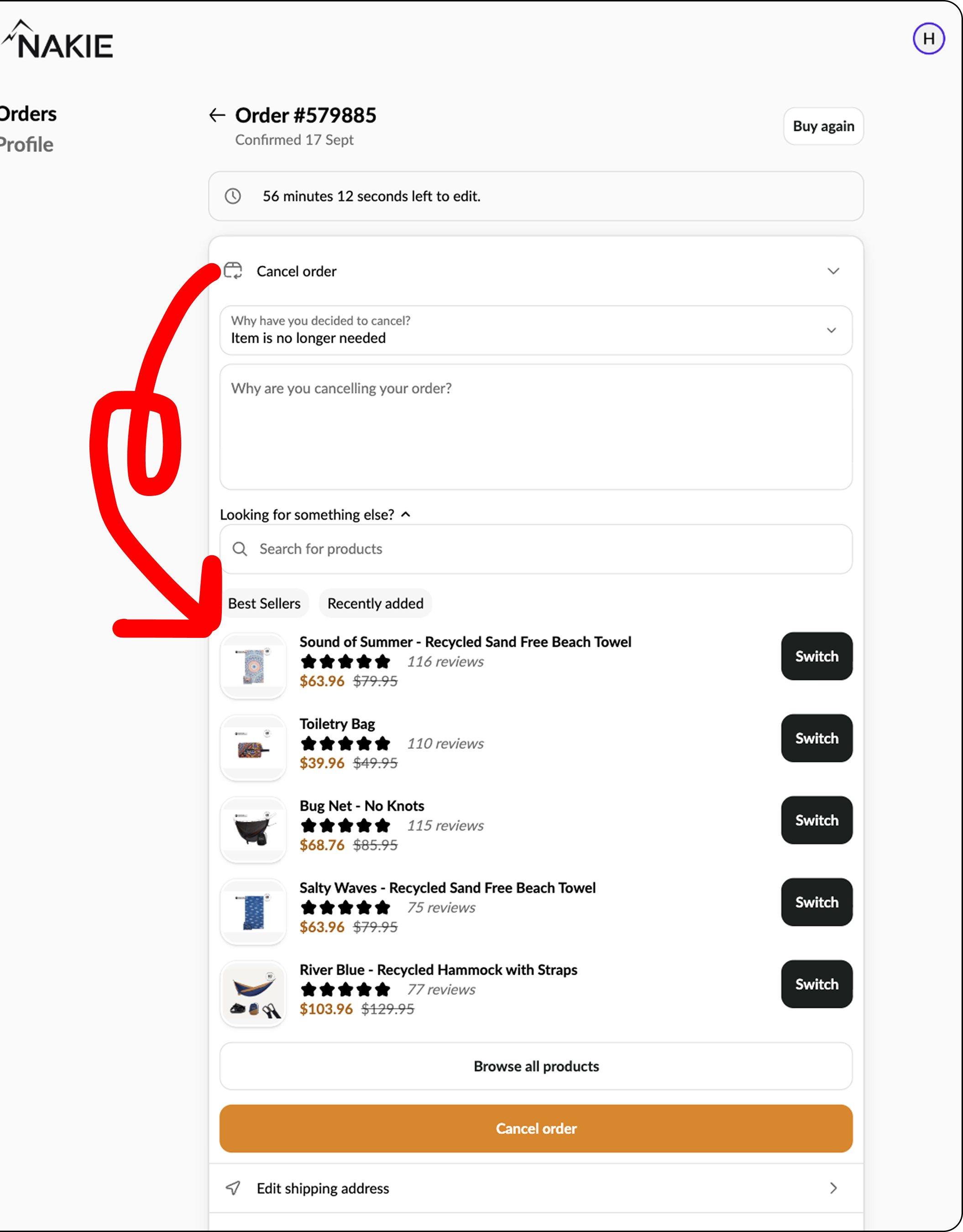
Some merchants offer a short pre-fulfillment order-edit window on the order status page for eligible pickup orders—same category of tooling as ship-to-home quantity or variant fixes before release to fulfillment. Order Editing and similar public Shopify App Store apps market configurable customer-initiated changes before pick; compare any vendor to location inventory, mixed carts, and ready-for-pickup cut-offs. This article does not describe internal product mechanics.
In-store associates may have POS permissions shoppers lack; align ecommerce macros with what stores are allowed to do without calling HQ.
Help-centre FAQ (customer-facing draft)
Can I change which store I pick up from?
If your order is still processing and the other store has stock, we may be able to help. Contact us with your order number. Once your order is ready for pickup, changes may not be possible.
Can I change pickup to shipping instead?
Define whether conversions are supported or whether you must cancel and place a new delivery order (shipping fees and promos may differ).
How long will you hold my order?
We hold ready pickup orders for [X days]. You’ll receive a notification when your order is ready.
Can I add an item to my pickup order after checkout?
If we have not finished preparing your order, ask support or visit [link]. After ready for pickup, you may need a separate purchase.
FAQ
Are BOPIS post-checkout rules the same as ship-to-home on Shopify?
No. Pickup orders bind to a fulfillment location and store workflow. Shipping-address edits and carrier intercepts do not apply to pure pickup lines. Mixed carts need split handling.
Can customers change pickup time in the Shopify checkout confirmation email flow by default?
Core Shopify does not guarantee a buyer-facing pickup reschedule link after checkout. Merchants implement policy through support, store ops, apps, or custom order status experiences.
What if the wrong store was selected because of GPS or default store?
Treat as a store-change request while processing; document whether you honour first-time mistakes with a one-time transfer.
When is cancel-and-reorder the right answer for pickup?
When location reassignment is blocked, payment cannot be adjusted, or the order is ready and the customer wants a completely different cart. State refund timing on the original pickup order.
Do pickup orders support returns after collection?
After pickup completion, use your retail return or exchange policy for brought-back goods—not pre-ship order edits.
How should staff handle “I’m running late” messages?
If policy allows hold extensions, note the order and new expiry in admin or POS; if not, communicate no-show restock rules before the customer arrives.
Summary
On Shopify BOPIS and pickup orders, customers most often ask to change store, timing, contact details, or line items—not a shipping address. Flexibility is highest while the order is processing; it drops sharply when the store marks the order ready for pickup or completes handoff.
Omnichannel merchants reduce friction by separating pickup macros from ship-to-home playbooks, publishing hold times and status definitions, and offering optional pre-fulfillment order-edit paths where inventory and store ops allow. Order Editing is one public Shopify App Store option to evaluate alongside POS and location rules.
For documentation and help-centre structure, see the Order Editing documentation on orderediting.com.