
“Can you just change my order?” and “I need to return this” often land in the same inbox—but they are different operational paths. Order edits fix the original order before it ships. Returns and exchanges handle physical goods after fulfillment. Mixing the two in support macros creates broken promises: customers expect a swap when the warehouse has already handed the package to a carrier.
This guide is for operations and CX leaders designing post-purchase policy on Shopify. It compares when an edit fits, when a return or exchange fits, and how to document both for your team and help centre.
Quick answer
| Path | Best when | Typical customer goal |
|---|---|---|
| Order edit | Order is unfulfilled (or not yet released to pick); inventory and payment allow a new total | Fix address, variant, quantity, or line items on the same order number |
| Return | Item shipped or delivered; customer sends product back per policy | Refund, store credit, or compliance with “changed my mind” rules |
| Exchange | Same as return, but you ship a replacement SKU | Size swap, colour change, or warranty replacement |
| Cancel and reorder | Edits blocked by payment, promotions, or product type; customer accepts a fresh checkout | Clean slate with a new discount or payment method |
There is no universal winner. Your policy should name which path applies at each fulfillment stage and product category.
Why merchants confuse edits and returns
Customers use vague language. “Change my order” might mean remove a line before ship—or exchange a sweater after try-on. Support agents hear “return” when the customer has not received tracking yet and an edit would still work.
Internal confusion adds cost:
- Promising an exchange while the order is still unfulfilled skips a cheaper edit.
- Attempting admin line deletes after fulfillment fails and erodes trust.
- Returns portals get tickets that belong in a pre-ship edit queue.
Training and macros should start with one question: Has this line fulfilled yet?
Order edits: policy-level fit
An order edit (staff-led in Shopify admin or customer self-service before your cut-off) keeps one order record. It fits when the mistake is known before the warehouse commits to the current version of the order.
Strong fit for edits
- Wrong shipping address or contact phone on an unfulfilled order.
- Wrong size or colour variant while pick has not started and stock exists.
- Duplicate line or quantity mistake (“I meant to order one, not three”).
- Adding a forgotten accessory to the same shipment window.
Weaker fit for edits
- Personalized, made-to-order, or production-started SKUs where changing the line is not reversible.
- Digital goods already delivered at purchase.
- Orders where payment providers cannot adjust authorization after capture (support may need cancel-and-reorder or manual goodwill instead).
- Marketplace or split-vendor carts where one line cannot be changed independently in your admin view.
Edits still require operational checks: inventory at the assigned location, tax and shipping recalculation, discount rules, and sync to your 3PL or WMS. An edit in Shopify that never reaches the warehouse is a common failure mode—document sync expectations in your internal playbook.
Self-service vs support-led edits
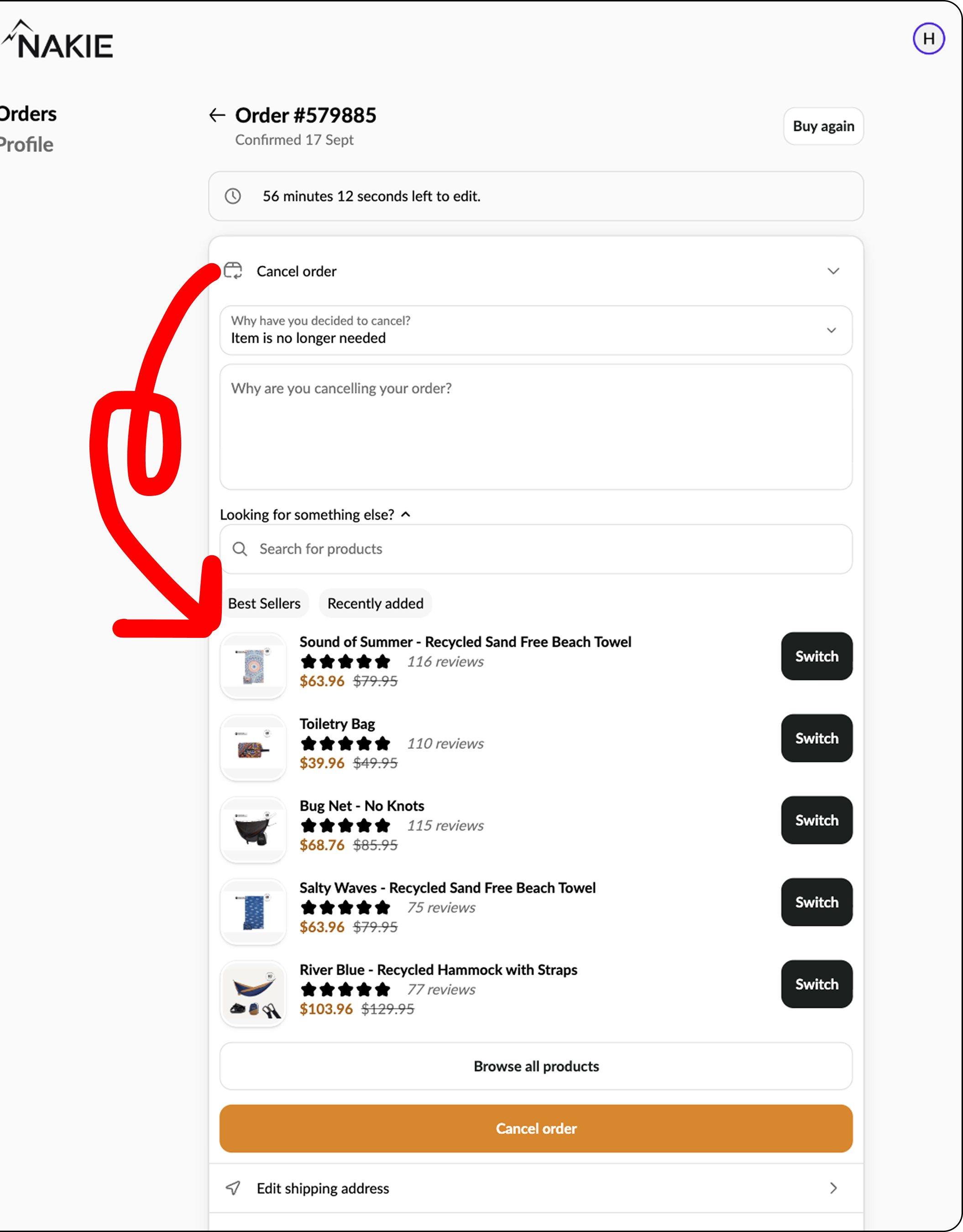
Low-volume stores can handle every edit in admin. At scale, merchants often define a post-purchase editing window on the order status page or customer account—same family of workflows as address or quantity changes before fulfillment. Public apps on the Shopify App Store, including Order Editing, market configurable customer-initiated changes before release to pick; this article stays educational and does not describe any vendor’s internal mechanics.
Returns and exchanges: policy-level fit
Once an order is fulfilled, the physical product is in motion or at the customer’s door. The standard retail path is return, exchange, or store credit under your published policy—not an in-place line edit.
Strong fit for returns or exchanges
- Fit or quality issues discovered after try-on (apparel, footwear).
- Wrong item received (mis-pick) after delivery.
- “Changed my mind” within your disclosed return window.
- Warranty or defect claims after use.
Exchange vs refund-only
Exchanges preserve revenue when the customer wants a different variant of the same product. They cost more operationally: inbound logistics, QC, restock, and outbound reship. Refund-only is simpler when inventory is uncertain or the customer prefers cash back.
Document whether exchanges are size-for-size only, whether customers pay return shipping, and how long replacement stock is held.
Returns vs “edit” in customer language
Macros should clarify:
- Before ship: “We can update your order while it has not left our warehouse.”
- After ship: “Your package is on the way; our return portal / support team will help with an exchange or refund per policy.”
That distinction reduces tickets closed with “we’ll change it” when the carrier already has the box.
Timing and fulfillment state
| Fulfillment state | Primary path | Notes |
|---|---|---|
| Unfulfilled, not in pick | Order edit | Fastest CX when inventory and payment allow |
| Unfulfilled, in pick or label printed | Edit if warehouse can stop; else intercept or reship policy | Define a hard cut-off with your 3PL |
| Partially fulfilled | Line-by-line: edit remaining unfulfilled lines; returns for shipped lines | Communicate per line in the thread |
| Fulfilled / delivered | Return or exchange | Admin line delete is not a substitute for physical return |
“Timing” also means your cut-off: many brands accept edits until one hour before warehouse release, then manual review only.
Inventory and product type
Inventory: Edits require available stock at the fulfillment location tied to the order. Returns put units back into sellable or damaged buckets per your QC rules.
Product type: Final sale, hygiene-sealed goods, perishables, and custom engraving often restrict post-purchase changes. Flag these in support macros and on product pages so agents do not offer edits or returns you cannot honour.
Bundles and promotions: Removing one line or changing a variant may break “spend $X get Y” rules. Decide whether support substitutes SKUs, issues manual discounts, or routes to cancel-and-reorder.
Cancel-and-reorder as a documented fallback
When edits are blocked but the customer still wants a different cart, cancel the original order (with refund per policy) and place a new order—or send a draft checkout link.
Use this path when:
- The customer needs a new promo code applied cleanly at checkout.
- Payment state prevents partial adjustments on the original order.
- The entire order contents are wrong and a fresh cart is faster than multiple line edits.
Trade-offs include customer friction, possible loss of the reorder, and marketing attribution on the new session. Keep cancel-and-reorder as a fallback, not the default for every pre-ship ticket.
Help-centre and macro guidance
Publish a customer-facing article that mirrors your internal stages:
- Check order status (processing vs shipped).
- Link to self-service edit tools if you offer them before your cut-off.
- Link to returns portal or exchange instructions after delivery.
- State non-returnable categories and final sale rules.
Internal macro skeleton (adapt tone to your brand):
- Unfulfilled + in policy: Offer edit steps or confirm you will edit in admin; state when fulfillment resumes.
- In transit: Set expectations on intercept fees or wait-for-delivery return.
- Delivered: Return/exchange window, label steps, refund timing.
Link macros to the same help-centre URLs customers see so agents and self-service stay aligned.
FAQ
Are order edits the same as returns on Shopify?
No. Edits change an unfulfilled order before completion of fulfillment. Returns handle products after shipment or delivery. Shopify admin supports many pre-ship changes for staff; customer-facing edit flows are merchant-defined.
Should we always prefer edits over returns?
When the order is still unfulfilled and stock exists, edits usually beat returns on speed and cost. After delivery, return or exchange is the normal path.
Can we offer exchanges before shipment instead of editing the variant?
You can, but editing the variant on the same order avoids return labels and double handling. Exchanges before ship are sometimes used when your stack cannot edit variants reliably—document that exception.
What if the customer wants a refund but the order has not shipped?
That is often a cancellation or line removal (partial refund), not a return. Separate “cancel before ship” from “return after delivery” in your FAQ.
How do edits interact with free shipping thresholds?
Changing lines or variants can change subtotal and shipping eligibility. Decide whether self-service edits show updated totals or whether support absorbs small differences on honest mistakes.
Do B2B or wholesale orders follow the same rules?
Wholesale contracts often override consumer return windows. Route those accounts to a dedicated macro and portal if applicable.
Summary
On Shopify, order edits belong in the pre-fulfillment window: fix the order in place when inventory, payment, and warehouse sync allow. Returns and exchanges belong after fulfillment: physical goods, restocking, and policy timelines. Cancel-and-reorder fills gaps when edits cannot run cleanly.
Ops and CX leaders who publish stage-based rules—and optional self-service order-edit windows before the warehouse runs—give support a consistent decision tree instead of ticket-by-ticket improvisation. Order Editing is one public Shopify App Store option for merchant-configured customer changes before release to fulfillment; compare any tool against your cut-off times, product restrictions, and return policy.
For setup guides and help-centre structure, see the Order Editing documentation on orderediting.com.